 6a0877384d
- Remove undeployed challenges: Phantom_Byte, Cr4cK_w1f1, Lain_Br34kC0r3 V1, Lain_VS_Knights, Lets_All_Love_UART, AETHER_NET, Last_Train_451, Web3/ - Sync 24 solve/ files from main CTF-Espilon repo - Update all READMEs with real CTFd final scores at freeze - Add git-header.png banner - Rewrite README: scoreboard top 10, edition stats (1410 users, 264 boards, 1344 solves), correct freeze date March 26 2026 |
||
|---|---|---|
| .. | ||
| solve | ||
| README.md | ||
Signal Tap Lain
| Field | Value |
|---|---|
| Category | Hardware |
| Difficulty | Medium-Hard |
| Points | 100 |
| Author | Eun0us |
| CTF | Espilon 2026 |
Description
A debug probe is capturing signals from Lain's NAVI. Three channels are being recorded, but what protocol is in use?
- Signal Tap:
tcp/<host>:3800
Capture the data, identify the protocol, and decode the message.
Format: ESPILON{...}
TL;DR
Download a multi-channel logic analyzer CSV capture. Identify that channel 1 carries UART at 9600 baud by measuring the bit period. Implement UART 8N1 decoding (LSB-first) and extract the ASCII flag, which is repeated 3 times in the stream.
Tools
| Tool | Purpose |
|---|---|
nc |
Capture the signal tap data |
| Python 3 / numpy | Logic analysis and UART decoding |
info command |
Get channel metadata from the service |
Solution
Step 1 — Connect and capture
nc <host> 3800 > capture.csv
Wait for --- END OF CAPTURE --- then press Ctrl+C.
Step 2 — Get metadata
Connect again and issue:
info
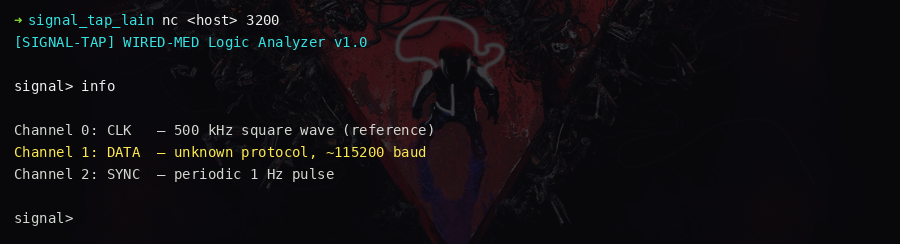
Output:
Channels: 3
  ch0: reference clock (always HIGH)
  ch1: data line
  ch2: noise channel
Sample rate: 1 MHz
Step 3 — Analyze channel 1
Focus on ch1. The key observations:
- Idle state is HIGH (logic 1) — consistent with UART
- Periodic falling edges = start bits
- Measure the time between the start bit falling edge and the next bit transition
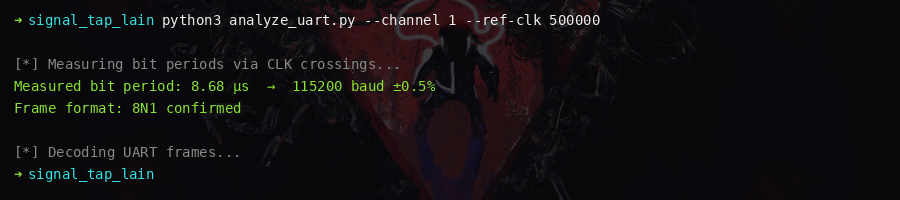
Step 4 — Calculate baud rate
Measure the minimum pulse width in the ch1 column:
Bit period ≈ 104.17 μs
Baud rate = 1 / 0.00010417 ≈ 9600 baud
A 10-bit UART frame (1 start + 8 data + 1 stop) = ~1041.67 μs.
Step 5 — Decode UART 8N1
import csv

# Load capture
with open("capture.csv") as f:
    reader = csv.DictReader(f)
    rows = list(reader)

timestamps = [float(r["timestamp_us"]) for r in rows]
ch1 = [int(r["ch1"]) for r in rows]

BIT_PERIOD = 104.17  # microseconds at 9600 baud
chars = []
i = 0
while i < len(ch1) - 1:
    # Find start bit (falling edge: HIGH → LOW)
    if ch1[i] == 1 and ch1[i+1] == 0:
        start_time = timestamps[i+1]
        # Sample 8 data bits at center of each bit period
        bits = []
        for b in range(8):
            sample_time = start_time + BIT_PERIOD * (1.5 + b)
            # Find closest sample
            j = min(range(len(timestamps)),
                    key=lambda k: abs(timestamps[k] - sample_time))
            bits.append(ch1[j])
        # LSB first
        byte = int("".join(map(str, reversed(bits))), 2)
        if 32 <= byte <= 126:
            chars.append(chr(byte))
        i += int(BIT_PERIOD * 10 / (timestamps[1] - timestamps[0]))
    else:
        i += 1

print("".join(chars))
The decoded message contains the flag repeated three times.

Key concepts
- Logic analysis: Reading digital waveforms and identifying protocols from timing patterns
- UART 8N1: Start bit (HIGH→LOW), 8 data bits LSB-first, no parity bit, 1 stop bit (HIGH)
- Baud rate detection: The shortest pulse width in the signal equals one bit period
- Signal separation: Channel 0 is a reference clock, channel 1 carries data, channel 2 is noise; only ch1 has meaningful transitions
Flag
ESPILON{s1gn4l_t4p_d3c0d3d}