
145 lines
2.9 KiB
Markdown
145 lines
2.9 KiB
Markdown
# NAVI I2C Sniff
|
||
|
||
| Field | Value |
|
||
|-------|-------|
|
||
| Category | Hardware |
|
||
| Difficulty | Medium-Hard |
|
||
| Points | 500 |
|
||
| Author | Eun0us |
|
||
| CTF | Espilon 2026 |
|
||
|
||
---
|
||
|
||
## Description
|
||
|
||
You have gained access to the I2C bus inside Lain's NAVI computer.
|
||
Multiple devices are connected: an EEPROM, a temperature sensor, and a cryptographic IC.
|
||
|
||
Scan the bus, probe each device, and recover the encrypted secret.
|
||
|
||
- I2C Bus: `tcp/<host>:3300`
|
||
|
||
Format: **ESPILON{...}**
|
||
|
||
---
|
||
|
||
## TL;DR
|
||
|
||
Scan the I2C bus to find three devices. A hidden register in the temperature sensor
|
||
points to the crypto IC. The crypto IC is locked — send the unlock code to reveal the XOR key.
|
||
Use the key to decrypt the EEPROM contents and recover the flag.
|
||
|
||
---
|
||
|
||
## Tools
|
||
|
||
| Tool | Purpose |
|
||
|------|---------|
|
||
| `nc` | Connect to the I2C bus interface |
|
||
| Python 3 | XOR decryption |
|
||
|
||
---
|
||
|
||
## Solution
|
||
|
||
|
||
|
||
### Step 1 — Connect
|
||
|
||
```bash
|
||
nc <host> 3300
|
||
```
|
||
|
||
> 📸 `[screenshot: I2C bus interface prompt]`
|
||
|
||
### Step 2 — Scan the bus
|
||
|
||
```text
|
||
scan
|
||
```
|
||
|
||
Discovers three devices:
|
||
|
||
```
|
||
I2C Address 0x50 [EEPROM]
|
||
I2C Address 0x48 [Temperature Sensor]
|
||
I2C Address 0x60 [Crypto IC]
|
||
```
|
||
|
||
> 📸 `[screenshot: scan output listing three I2C devices]`
|
||
|
||
### Step 3 — Read the temperature sensor's hidden register
|
||
|
||
```text
|
||
read 0x48 0x07 16
|
||
```
|
||
|
||
Returns: `key@0x60:0x10` — a hint pointing to register 0x10 of the crypto IC at address 0x60.
|
||
|
||
### Step 4 — Try reading the crypto IC (locked)
|
||
|
||
```text
|
||
read 0x60 0x10 32
|
||
```
|
||
|
||
Returns all zeros — the IC is locked.
|
||
|
||
Check the lock status register:
|
||
|
||
```text
|
||
read 0x60 0x00 1
|
||
```
|
||
|
||
Returns `0x01` (locked).
|
||
|
||
### Step 5 — Unlock the crypto IC
|
||
|
||
Send the unlock code `0xA5` to the control register:
|
||
|
||
```text
|
||
write 0x60 0x00 0xA5
|
||
```
|
||
|
||
### Step 6 — Read the XOR key
|
||
|
||
```text
|
||
read 0x60 0x10 32
|
||
```
|
||
|
||
Now returns the actual 32-byte key: `NAVI_WIRED_I2C_CRYPTO_KEY_2024!!`
|
||
|
||
> 📸 `[screenshot: crypto IC returning the key after unlock]`
|
||
|
||
### Step 7 — Read the EEPROM
|
||
|
||
```text
|
||
read 0x50 0x00 64
|
||
```
|
||
|
||
Returns XOR-encrypted data as a hex string.
|
||
|
||
### Step 8 — Decrypt the flag
|
||
|
||
```python
|
||
eeprom_hex = "..." # hex from read 0x50
|
||
key = b"NAVI_WIRED_I2C_CRYPTO_KEY_2024!!"
|
||
enc = bytes.fromhex(eeprom_hex)
|
||
flag = bytes(b ^ key[i % len(key)] for i, b in enumerate(enc))
|
||
print(flag.rstrip(b'\x00').decode())
|
||
```
|
||
|
||
> 📸 `[screenshot: Python decryption script printing the flag]`
|
||
|
||
### Key concepts
|
||
|
||
- **I2C bus scanning**: Enumerate devices by probing every 7-bit address (0x00–0x7F)
|
||
- **Multi-device interaction**: Data from one device (temp sensor hint) unlocks another (crypto IC)
|
||
- **Access control**: The crypto IC requires an unlock sequence before revealing its key register
|
||
- **XOR encryption**: Simple symmetric cipher used for data at rest in EEPROM
|
||
|
||
---
|
||
|
||
## Flag
|
||
|
||
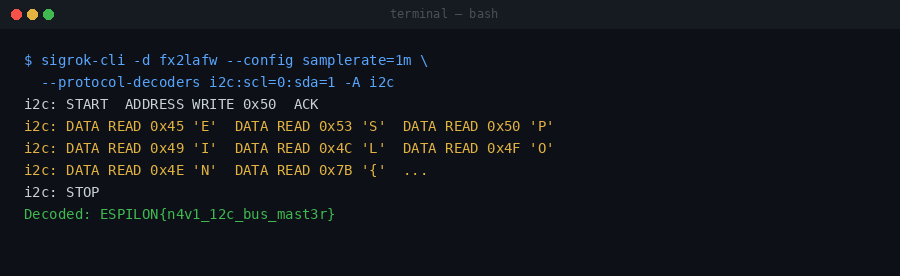
`ESPILON{n4v1_12c_bus_mast3r}`
|