 8b6c1cd53d
Crypto:
- Replace broken ChaCha20 (static nonce) with ChaCha20-Poly1305 AEAD
- HKDF-SHA256 key derivation from per-device factory NVS master keys
- Random 12-byte nonce per message (ESP32 hardware RNG)
- crypto_init/encrypt/decrypt API with mbedtls legacy (ESP-IDF v5.3.2)
- Custom partition table with factory NVS (fctry at 0x10000)

Firmware:
- crypto.c full rewrite, messages.c device_id prefix + AEAD encrypt
- crypto_init() at boot with esp_restart() on failure
- Fix command_t initializations across all modules (sub/help fields)
- Clean CMakeLists dependencies for ESP-IDF v5.3.2

C3PO (C2):
- Rename tools/c2 + tools/c3po -> tools/C3PO
- Per-device CryptoContext with HKDF key derivation
- KeyStore (keys.json) for master key management
- Transport parses device_id:base64(...) wire format

Tools:
- New tools/provisioning/provision.py for factory NVS key generation
- Updated flasher with mbedtls config for v5.3.2

Docs:
- Update all READMEs for new crypto, C3PO paths, provisioning
- Update roadmap, architecture diagrams, security sections
- Update CONTRIBUTING.md project structure
10 KiB
Espilon

Embedded ESP32 Agent Framework for Security Research and IoT



Important
: Espilon is intended for security research, authorized penetration testing, and education. Unauthorized use is illegal. Always obtain written permission before any deployment.
Table of Contents
- Full Documentation
- Quick Start
- What is Espilon?
- Architecture
- Available Modules
- Tools
- Security
- Use Cases
- Roadmap
- License
- Contributors
- Useful Links
- Support
Full Documentation
View the full documentation here
The MkDocs documentation includes:
- Step-by-step installation guide
- Translate EN/FR
- WiFi and GPRS configuration
- Module and command reference
- Multi-device flasher guide
- C2 protocol specification
- Examples and use cases
Quick Start
Prerequisites
- ESP-IDF v5.3.2
- Python 3.8+
- ESP32 (any compatible model)
- LilyGO T-Call for GPRS mode (optional)
Quick Installation
# 1. Install ESP-IDF v5.3.2
mkdir -p ~/esp
cd ~/esp
git clone -b v5.3.2 --recursive https://github.com/espressif/esp-idf.git
cd esp-idf
./install.sh esp32
. ./export.sh

# 2. Clone Espilon
cd ~
git clone https://github.com/Espilon-Net/epsilon-source.git
cd Espilon-Net/espilon_bot

# 3. Configure with menuconfig or tools/flasher/devices.json
idf.py menuconfig

# 4. Build and flash
idf.py build
idf.py -p /dev/ttyUSB0 flash monitor
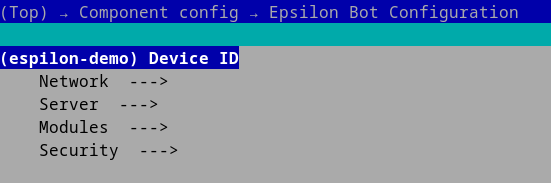
Minimal configuration (menuconfig):
Espilon Bot Configuration
  |- Device ID: "your_unique_id"
  |- Network -> WiFi
  |   |- SSID: "YourWiFi"
  |   |- Password: "YourPassword"
  |- Server
      |- IP: "192.168.1.100"
      |- Port: 2626
What is Espilon?
Espilon transforms affordable ESP32 microcontrollers (~$5) into powerful networked agents for:
- Security research: WiFi testing, network reconnaissance, IoT pentesting
- Education: Learning embedded systems, network protocols, FreeRTOS
- IoT prototyping: Distributed communication, monitoring, sensors
Connectivity Modes
| Mode | Hardware | Range | Use Case |
|---|---|---|---|
| WiFi | Standard ESP32 | 50-100m | Labs, buildings |
| GPRS | LilyGO T-Call | National (2G) | Mobile, remote |
Architecture
+---------------------------------------------------------+
|                     ESP32 Agent                         |
|  +-----------+  +----------+  +---------------------+   |
|  |  WiFi/    |->| ChaCha20 |->|   C2 Protocol       |   |
|  |  GPRS     |<-| Poly1305 |<-|  (nanoPB/TCP)       |   |
|  +-----------+  +----------+  +---------------------+   |
|         |              |                 |              |
|  +-----------------------------------------------------+|
|  |           Module System (FreeRTOS)                  ||
|  |  [Network] [FakeAP] [Recon] [Custom...]             ||
|  +-----------------------------------------------------+|
+---------------------------------------------------------+
                        | Encrypted TCP
              +---------------------+
              |   C2 Server (C3PO)  |
              |  - Device Registry  |
              |  - Group Management |
              |  - CLI Interface    |
              +---------------------+
Key Components
- Core: Network connection, ChaCha20-Poly1305 AEAD + HKDF key derivation, nanoPB protocol
- Modules: Extensible system (Network, FakeAP, Recon, etc.)
- C2 (C3PO): Python asyncio server for multi-agent control
- Flasher: Automated multi-device flashing tool
Available Modules
Important note: Modules are mutually exclusive. You must choose only one module during configuration via menuconfig.
System Module (Built-in, always active)
Basic system commands:
system_reboot: Reboot the ESP32system_mem: Display memory usage (heap free, heap min, internal free)system_uptime: Uptime since boot
Network Module
Module for network reconnaissance and testing:
ping <host> [args...]: ICMP connectivity testarp_scan: Discover hosts on local network via ARPproxy_start <ip> <port>: Start a TCP proxyproxy_stop: Stop the running proxydos_tcp <ip> <port> <count>: TCP load test (authorized use only)
FakeAP Module
Module for creating simulated WiFi access points:
fakeap_start <ssid> [open|wpa2] [password]: Start a fake access pointfakeap_stop: Stop the fake APfakeap_status: Display status (AP, portal, sniffer, clients)fakeap_clients: List connected clientsfakeap_portal_start: Enable captive portalfakeap_portal_stop: Disable captive portalfakeap_sniffer_on: Enable network traffic capturefakeap_sniffer_off: Disable capture
Recon Module
Reconnaissance and data collection module. Two modes available:
Camera Mode (ESP32-CAM)
cam_start <ip> <port>: Start UDP video streaming (~7 FPS, QQVGA)cam_stop: Stop streaming
BLE Trilateration Mode
trilat start <mac> <url> <bearer>: Start BLE trilateration with HTTP POSTtrilat stop: Stop trilateration
Configuration: idf.py menuconfig -> Espilon Bot Configuration -> Modules
Choose only one module:
CONFIG_MODULE_NETWORK: Enable the Network ModuleCONFIG_MODULE_FAKEAP: Enable the FakeAP ModuleCONFIG_MODULE_RECON: Enable the Recon Module- Then choose:
CameraorBLE Trilateration
- Then choose:
Tools
Multi-Device Flasher
Automated flasher to configure multiple ESP32s:
cd tools/flasher
python3 flash.py --config devices.json
devices.json:
{
  "project": "/path/to/espilon_bot",
  "devices": [
    {
      "device_id": "esp001",
      "port": "/dev/ttyUSB0",
      "network_mode": "wifi",
      "wifi_ssid": "MyNetwork",
      "wifi_pass": "MyPassword",
      "srv_ip": "192.168.1.100"
    }
  ]
}
See tools/flasher/README.md for complete documentation.
Device Provisioning
Each device needs a unique master key flashed into its factory NVS partition before first use:
cd tools/provisioning
python3 provision.py --device-id my-device --port /dev/ttyUSB0
This generates a 32-byte random master key, writes it to the factory NVS partition, and saves it to the C2 keystore (keys.json).
See tools/provisioning/ for details.
C2 Server (C3PO)
Command & Control server:
cd tools/C3PO
pip3 install -r requirements.txt
python3 c3po.py
Full C2 documentation and command list: see tools/C3PO/README.md.
Security
Encryption
- ChaCha20-Poly1305 AEAD for authenticated encryption of all C2 communications
- HKDF-SHA256 key derivation (per-device master key + device ID salt)
- Random 12-byte nonce per message (ESP32 hardware RNG)
- Per-device master keys stored in factory NVS partition (read-only)
- Protocol Buffers (nanoPB) for serialization
Provision each device with a unique master key using tools/provisioning/provision.py. Keys are never hardcoded in firmware.
Responsible Use
Espilon should only be used for:
- Authorized penetration testing
- Ethical security research
- Education and training
- Legitimate IoT prototyping
Prohibited: Unauthorized access, malicious attacks, privacy violations.
Use Cases
WiFi Pentesting
- Network security auditing
- WPA2/WPA3 robustness testing
- Network mapping
IoT Security Research
- IoT device testing
- Protocol analysis
- Vulnerability detection
Education
- Cybersecurity labs
- Embedded systems courses
- CTF competitions
Roadmap
V2.0 (In Progress)
- ChaCha20-Poly1305 AEAD + HKDF crypto upgrade
- Per-device factory NVS key provisioning
- C3PO C2 rewrite with per-device crypto
- Mesh networking (BLE/WiFi)
- OTA updates
- Collaborative multilateration
- Memory optimization
Future
- Custom Espilon PCB
- ESP32-S3/C3 support
- Module SDK for third-party extensions
- Web UI for C2
License
Espilon is licensed under MIT with a security addendum.
See LICENSE for full details.
In summary:
- Free use for research, education, development
- Modification and distribution allowed
- Obtain authorization before any deployment
- Malicious use strictly prohibited
Contributors
- @Eun0us - Core architecture, modules
- @off-path - C2 server, protocol
- @itsoktocryyy - Network features, work on Mod Wall Hack
- @wepfen - Documentation, tools
Contributing
Contributions welcome! See CONTRIBUTING.md.
Join us:
- Report bugs
- Propose features
- Submit PRs
- Improve documentation
Useful Links
- Full documentation
- ESP-IDF Documentation
- LilyGO T-Call
- French README: README.md
Support
- Issues: GitHub Issues
- Discussions: GitHub Discussions
Originally presented at Le Hack (June 2025)
Made with love for security research and education